

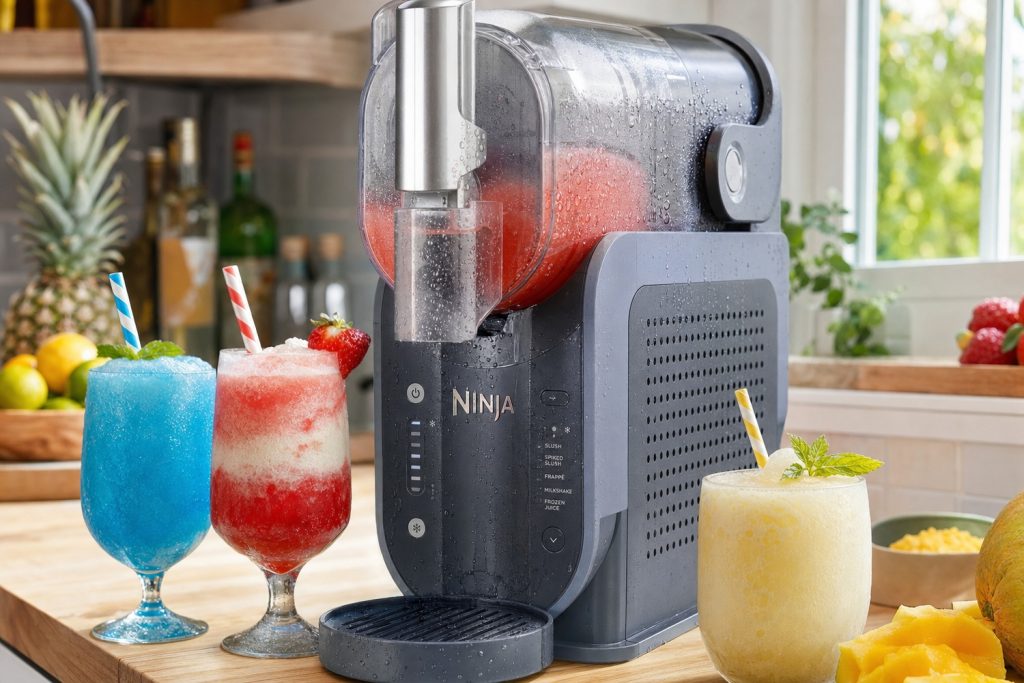
If you find water under or on the walls of your machine, don’t worry: in the vast majority of cases, it is simple, normal condensation, a sign that your compressor is working perfectly. This summer, with my kitchen at 30°C, my Ninja Slushi Max had so much condensation that it wet the countertop. Before imagining a catastrophic failure or a faulty seal, it is very easy to check whether it is a real leak of your mixture or just the machine “sweating” due to thermal shock. Here is how to diagnose it correctly.
Condensation on the Ninja Slushi: why it is a normal phenomenon
The secret of Ninja Slushi machines lies in their integrated WhisperChill compressor, which keeps your drink cold for 12 hours. It is the RapidChill phase that brings the tank down to sub-zero temperatures: count on about 30 minutes for the FS301, 15 minutes for the FS601 and FS605 models. Naturally, when you cool a liquid inside a plastic tank while the room air is hot, thermal shock occurs. Ambient humidity then settles on the cold walls of the tank, creating water droplets. This is exactly the same principle as a glass of iced tea in the middle of the sun in August.
Do large models condense more?
Absolutely. The larger the thermal exchange surface, the more the unit will condense. The basic Ninja Slushi (FS301) has a 2.5 L tank, which limits the exposed area. However, if you own a model from the xl-max family, the condensation surface is much larger: the Ninja Slushi XL (FS601) displays 3.7 L and the Ninja Slushi Max (FS605) goes up to 4.4 L. On these large models, it is quite common to see water beading profusely all along the height of the plastic. If you are still hesitant between the three, I have detailed their differences in my comparison of Ninja Slushi models.
How to differentiate between simple condensation and a real leak?
So you don’t panic unnecessarily, I have developed a small foolproof method to know what is leaking from your machine.
| Verification criteria | Condensation symptom (Normal) | Leak symptom (Needs fixing) |
|---|---|---|
| The finger test | The water is clear, odorless, and doesn’t feel sticky at all. | The liquid is sticky, sweet, colored, or smells like alcohol. |
| Location | Diffuse droplets spread over the entire tank wall. | A pool concentrated just under the tap or at the back base of the tank. |
| During the RapidChill phase | Water appears gradually during the first 15 to 30 minutes of intense cooling. | Liquid leaks immediately upon filling, even before turning the unit on. |
Factors that aggravate your machine’s “sweating”
If you find that your device is producing really a lot of water, check your environment. Kitchen temperature and summer usage are the primary culprits. A room at 25°C will make the tank sweat much faster than a kitchen air-conditioned at 19°C.
Outdoor use (on a terrace) or near an open window also brings a constant flow of new humidity that condenses on the plastic. Finally, the impact of duration is significant: if you leave the machine in cold-hold mode for several hours in a row during a long party, the accumulation of condensation at the base will inevitably be greater.
If it is a real leak: the sealing points to check
If the finger test is conclusive and the liquid is sweet, you have a leak. Good news: the problem area is almost always the one that can be disassembled.
- The spout cover and its seal: this is the prime suspect, and the only sealing part you have to disassemble. Over time, the sugar in your preparation clogs the spout seal and prevents it from closing hermetically. Remove the spout cover and its seal, rinse with hot water, then dry them completely before reassembling.
- The tank base seal cannot be disassembled. The one located behind the evaporator is fixed in place by the manufacturer, and the official manual is explicit about the reason: “It is fixed in place to prevent any leakage.” Do not attempt to remove it, reposition it, or slide a tool behind it: you risk causing the very leak you wanted to correct. If the liquid is clearly coming from this area, it is a case for Ninja customer service, not for DIY disassembly.
- The empty test: always make it a habit to pour a little clear water into the tank after reassembly to check for leaks, before pouring your precious fruit or alcohol mixture.
My practical tips for managing condensation water on a daily basis
Since condensation is inevitable (and even desirable, because it proves the cold is there), here is how I manage it without damaging my countertop:
- Use an absorbent bar mat: I always place a rubber mat with a felt base under my FS605 Max. It soaks up the trickling water and protects the furniture.
- Wipe during service: keep a clean microfiber cloth next to the machine. Before serving your guests, a quick wipe on the walls gives the machine a cleaner look.
- The right location: avoid placing the device in a strong draft of hot, humid air, or right next to your boiling stovetop.
My anti-panic memo
The ultimate test is the touch test: if it’s pure water, don’t touch anything, it’s just condensation. If it’s sticky, even a little, empty the tank immediately, wash it, and focus on the spout cover and its seal: that’s the only sealing zone you need to disassemble. The tank base seal remains in place. It is fixed for a reason.
Frequently asked questions
Is it dangerous for the motor if water runs along the tank?
No. Condensation forms on the outer walls of the tank and drips towards your countertop, not inside the device. Just remember to wipe the plastic base after your use and avoid letting water stagnate under the machine.
Does the chosen program change the amount of condensation?
It’s minimal. Whether you are in Slush or Frozen Cocktail mode, the machine goes down to similar sub-zero temperatures. It is the ambient humidity in your room that dictates the amount of water on the walls, not the program.
Why is my machine making a colored puddle at the base?
A colored or sticky puddle indicates a real leak of your preparation, not condensation. Empty the tank, then inspect the spout cover and its seal: they can be removed, and sugar clogs them easily. If the leak comes from the bottom of the tank, do not force the fixed seal behind the evaporator, contact customer service.
In summary, seeing your Ninja Slushi shed a few tears of clear water is not a reason to return it to after-sales service, quite the contrary. It is proof that its WhisperChill system is doing its intensive cooling job. Did you get cold sweats seeing water beading under your machine for the first time? Do you have a trick to protect your countertop? Tell me in the comments!