
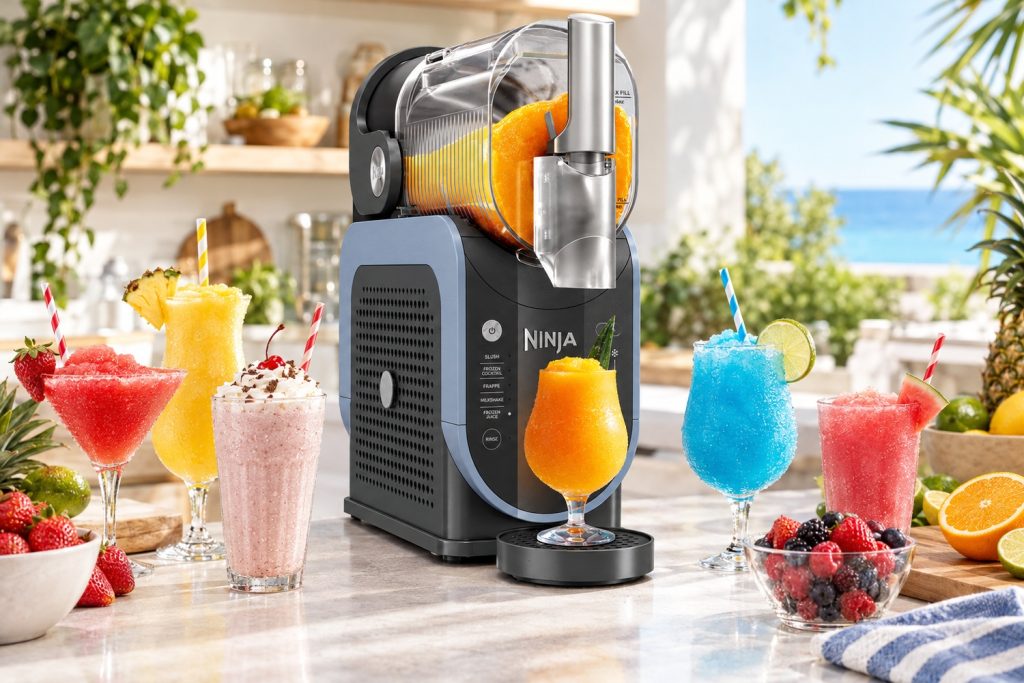
Yes, you can absolutely use plant-based or dairy-based mixtures in the Ninja Slushi, provided you maintain a minimum sugar level of 4% and only pour in cold liquids without any chunks. At first, I was hesitant to pour milk into the vessel for fear that it would spoil or freeze poorly. Then, after reading the manual and testing it on my machines, I understood that fat and lactose just require a different approach compared to a classic juice. When I made my first milkshake on the Ninja Slushi Max (FS605), I quickly realised that milk requires impeccable disassembly of the pour spout.
Yes, you can put milk in the Ninja Slushi (and it is designed for it)
The good news: the machine has two programmes designed for milk, Milkshake (on all three models) and Frappé (FS301 only). Where a water base gives a light slush, a milk base results in a proper dense milkshake.
The absolute rule: watch your milk’s sugar content
Sugar is not just a matter of taste, it is the machine’s true antifreeze. You must have at least 4% sugar, which is 4 g per 100 mL of liquid. Standard cow’s milk usually contains around 4.7 g of sugar (lactose) per 100 mL, so it is just above the threshold on its own. Check your bottle’s label and add a little sugar whenever the recipe includes cream or other low-sugar ingredients.
If you need to correct a lack of sugar, add 15 to 30 mL per serving (such as syrup, liquid sugar, or honey) and always mix them into the base before pouring it into the appliance, never directly into the vessel while it is running.
Plant-based milks (almond, oat, soy): pitfalls to avoid
The main danger comes from almond or soy milks labeled as having no added sugars. Without this antifreeze power, the liquid creates a gel that is too hard, which puts a strain on the auger. Oat drinks generally contain more sugars: read the label here as well.
You need to get into the habit of reading the nutritional label on your bottle. If your plant-based drink shows 1 g of carbohydrates per 100 mL, you must systematically compensate to reach the 4 g target. Add your syrup to a pitcher, stir, and only then fill your vessel. It is the same meticulous adjustment principle I use when I prepare a pineapple elderflower fizz mocktail in the Ninja Slushi to find the perfect balance of texture.
Which milk programme should you choose based on your model?
Not all appliances in the range share the exact same functions for dairy products.
| Model | Milkshake Programme | Frappé Programme |
|---|---|---|
| Ninja Slushi (FS301) | Yes | Yes |
| Ninja Slushi XL (FS601) | Yes | No |
| Ninja Slushi Max (FS605) | Yes | No |
The Milkshake programme is common to all three models, which allows you to create your dairy bases regardless of your machine. Conversely, the Frappé programme is an exclusive feature of the Ninja Slushi (FS301). If you have an XL or Max model, you can still obtain a very similar drink by using the Milkshake mode: three beeps will announce that the drink is ready.
Expect between 15 and 60 minutes depending on the volume, ingredients, and starting temperature. If the drink is too foamy, serve it within 30 minutes of the end of the programme and add 15 mL of double cream per 473 mL of prepared drink, as recommended by the manufacturer.
What you should never do with a dairy base
There are three critical mistakes not to make. Firstly, never pour in lukewarm or hot milk; the liquids must be thoroughly chilled before entering the vessel. Secondly, forget about adding solid ingredients like chocolate shavings or chunks of whole fruit: they risk blocking the auger.
Finally, the manufacturer is firm: never leave the dairy mixture in the vessel while storing the appliance. Milk spoils quickly at room temperature: the 12-hour cold-keep feature announced by the manufacturer concerns recipes without animal-based milk.
Care and hygiene: cleaning after dairy use
Cleaning requires rigour with fatty substances. The importance of the immediate RINSE cycle after use is enormous: this programme is used to circulate clean water without cooling, which prevents milk from drying inside the vessel. Start it as soon as you have finished serving.
Next, move on to meticulous disassembly: you must remove the spout cover and its seal to dry them individually before reassembling them. Rest assured about the rest of the dishwashing, the vessel and the auger are dishwasher safe, provided you place them on the bottom rack and without a heated drying cycle.
My anti-failure memo for dairy drinks
- I always check the label of my plant-based milk: if it is mentioned as having no sugar, I compensate with syrup.
- I mix my milk and sugar well in a pitcher before filling the vessel.
- As soon as the last cup is served, I start a RINSE cycle with clean water to make cleaning easier.
Frequently asked questions
Can I use unsweetened almond milk in the Ninja Slushi?
Yes, but you must add sugar (at least 4 g per 100 mL) via a syrup or honey before pouring it in. Without this, the liquid will harden and block the auger.
Should I heat the milk to infuse flavours before using it?
You can do that, but you will absolutely have to cool it down completely before using it. The machine only accepts cold liquids, never hot.
Can I leave the rest of my dairy drink in the machine for the next day?
No. The manufacturer specifies never to leave ingredients in the vessel during storage, especially with dairy products which can turn quickly.
How do I know if my milk lacks sugar during operation?
If the machine lacks sugar, it emits two beeps per minute and the temperature indicator lights turn on one by one as they go down.
In summary, preparing milk-based drinks is entirely within your reach if you control your sugar level and take care of the cleaning. It is an excellent way to explore indulgent textures, while varying with thicker textures, like my salted caramel milkshake. And you, what is your favourite base: classic cow’s milk or a plant-based alternative? Tell me what works best for you!