

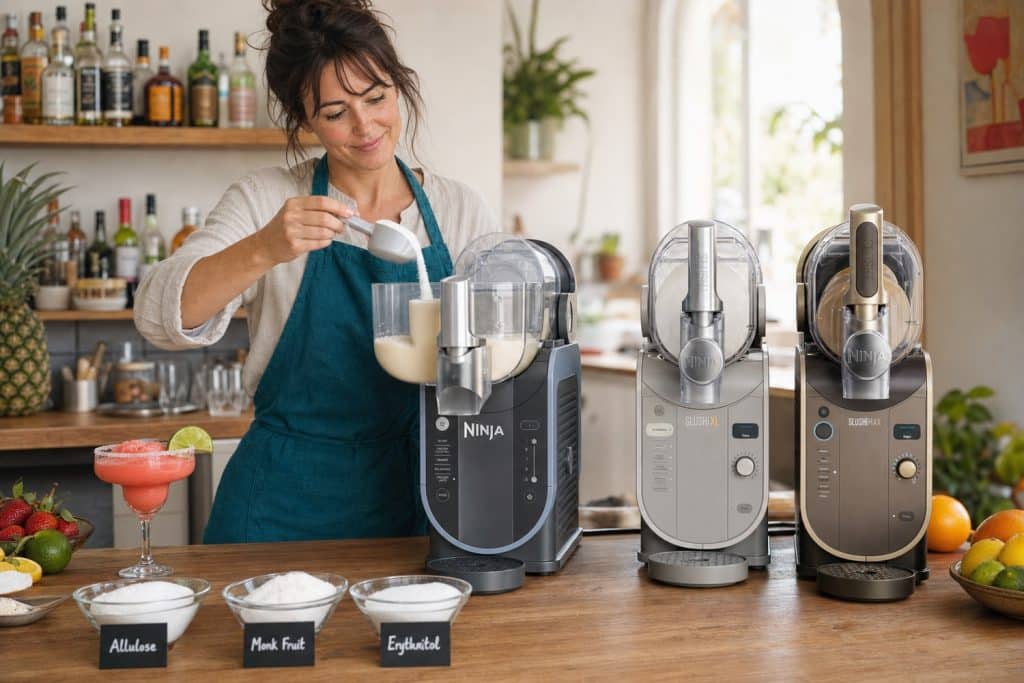
To successfully make a sugar-free slushie in your machine, you must balance two unrelated factors: sweetness and antifreeze capacity. Allulose is by far the best from a technical standpoint, but it is not authorized for sale in the European Union. In France, the solution that really works is xylitol, supplemented with a touch of monk fruit. Erythritol alone makes the texture sandy, and pure intense sweeteners like stevia will cause your mixture to freeze into a solid block. Here are the thresholds, dosages, and pitfalls, program by program.
Why the Ninja Slushi absolutely needs sugar (or a good substitute)
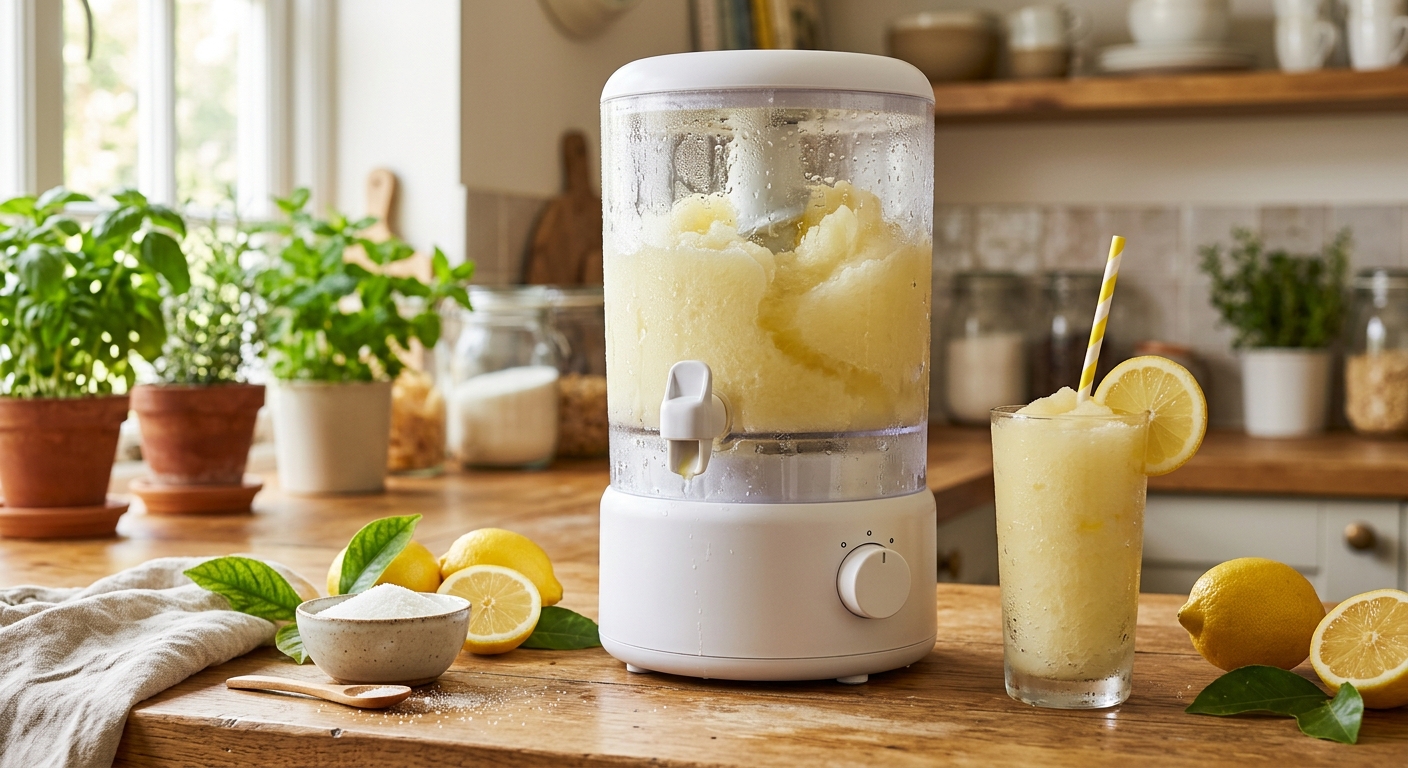
The secret to a good slushie is its freezing point. In a machine like the Ninja Slushi (FS301) or the Ninja Slushi Max (FS605), sugar acts as an antifreeze: it prevents the water from turning into a solid block of ice and keeps the mixture in that narrow range where it remains scoopable by the paddle.
Ninja quantifies this need, and this is the only number to remember before everything else: the mixture must contain at least 4 g of sugar per 100 ml (the UK manual rounds this to 5 g per 100 ml). Below this, the manufacturer warns that a ‘light’ drink can freeze solid and damage the device. For alcoholic versions, the window is just as precise: between 2.8% and 16% vol.
Therefore, we must distinguish between two main families of substitutes:
- Bulking agents (allulose, xylitol, erythritol): they provide volume, substance, and real antifreeze capacity.
- Intense sweeteners (stevia, monk fruit): they only provide sweetness, without any substance, and therefore have no effect on the freezing point.
If your machine starts beeping and flashing, or if it spins without ever thickening, it is almost always this dosage that is to blame. Other possible causes are detailed in my guide on the Ninja Slushi that freezes on one side and dispenses poorly.
Allulose: unbeatable on paper, but not for sale in Europe
Let’s start with the bad news, because it changes everything for a French reader. Allulose is not authorized for sale as a food ingredient in the European Union. It falls under the ‘novel food’ status and is awaiting authorization. The EFSA issued an opinion on May 6, 2025, regarding the file submitted by Petiva Europe SA and concluded that the safety of allulose ‘cannot be established’, not because it is dangerous, but because the applicant never provided the requested data since 2020. Four other files are still under review, including those from CJ-Tereos, Samyang, and Tate & Lyle. In other words, it is a matter of paperwork, not toxicity, but in the meantime, you will not find it on shelves.
Technically, however, it is the best choice, and most Anglo-Saxon recipes swear by it. Ninja even publishes an official sugar-free recipe built around it: 710 ml of light soda, 45 ml of liquid allulose, and 2 tablespoons of lemon juice, on the Slush program.
Be careful, however, of one piece of advice read everywhere that is false: the famous ‘1:1 ratio’ with sugar. Allulose is a simple sugar (molar mass 180 g/mol) whereas sucrose is a double sugar (342 g/mol). By mass, there are nearly twice as many molecules in solution, and the freezing point depression is approximately 1.9 times that of sugar, for a sweetening power of only 0.7 times. Replacing gram for gram, then adding more to compensate for the taste, amounts to doubling the dose of antifreeze. The result is not a machine that locks up, but a machine that runs for an hour without ever thickening. Instead, count on 60 to 70% of the weight of the sugar replaced, and boost the taste with an intense sweetener.
Xylitol: the real answer available in France
This is the sweetener that most articles forget, yet it is the one that ticks all the boxes on this side of the Atlantic. Xylitol is authorized in the European Union as an additive (E 967), without a set maximum dose, and it behaves remarkably well in the cold for two reasons.
First, its sweetening power is equivalent to that of sugar, which simplifies all taste adjustments. Second, and this is the decisive point, its solubility is enormous: about 169 g per 100 ml of water at room temperature, compared to only 37 g for erythritol. It therefore remains dissolved when the temperature drops, instead of coming out of the solution as crystals.
Regarding dosage, its molar mass of 152 g/mol gives it about 2.25 times the antifreeze power of sugar by mass. Starting from the manufacturer’s floor of 4 to 6 g of sugar per 100 ml, this places the target around 2 to 3 g of xylitol per 100 ml of mixture. This is a calculation, not a laboratory measurement: start in the middle of the range, taste, and adjust by half a gram on the next batch rather than improvising mid-cycle.
Two caveats to be aware of, and they are real. Above 10% polyols, a product must carry a mention of a laxative effect: at these dosages, you are very far from that, but serve reasonable portions. Also, xylitol is toxic to dogs, even in very small amounts: do not leave a leftover drink within reach of a snout.
Erythritol: the trap of solubility, not crystallization
Erythritol is the most widely sold polyol in supermarkets, often mixed with stevia. In a frozen drink, it has two drawbacks that compound each other.
The first is well known: the ‘cooling effect’, that almost minty sensation in the mouth, which is strongly amplified by the cold of the slushie. The second is poorly explained almost everywhere. People read that erythritol ‘crystallizes’; in reality, it exceeds its solubility limit. At 37 g per 100 ml at 25 °C, and much less when the temperature drops toward zero, it simply cannot remain dissolved and comes out of the solution as crystals. Hence this characteristic sandy texture.
This is also what explains why the only advice that works with it is to never use it alone: mixed with xylitol, fruit juice, or a little alcohol on the Frozen Cocktail program, you stay below its limit and the sandiness disappears.
Monk fruit and stevia: the volume trap
These two sweeteners are extremely powerful for taste, but they provide no substance and therefore no antifreeze power. A spoonful of stevia in a liter of flavored water is chemically pure water: it will freeze into a block.
You can therefore never use them pure in your machine. Their place is elsewhere, and it is very useful: as a taste corrector, once the xylitol has done the texture work. This is exactly the principle of commercial blends that combine monk fruit and a bulking agent.
How to dose according to the program?
Here is the summary, keeping in mind that the target always remains the same: the antifreeze equivalent of 4 to 6 g of sugar per 100 ml.
| Program | Recommended sweetener | Starting dosage |
|---|---|---|
| Slush | Xylitol, plus a touch of monk fruit | 2 to 3 g of xylitol per 100 ml. Smooth texture, no machine errors. |
| Frozen Cocktail | Xylitol, dosed low | 1.5 to 2 g per 100 ml: alcohol (2.8 to 16% vol) already does some of the antifreeze work. |
| Frappé (FS301 only) | Xylitol, or erythritol in a blend | 2 g per 100 ml. The fat in the milk slightly masks the sandiness of the erythritol. |
| Frozen Juice | Often nothing to add | A grape or apple juice already exceeds 10 g of sugar per 100 ml. |
This last case deserves a stop: before buying any substitute, look at what your base already contains. A 100% fruit mango slushie needs no addition, and a cola slushie works very well with a light soda corrected with a little xylitol.
If the machine still starts beeping and flashing, do not force the mechanism. Turn it off, add a little room-temperature liquid with xylitol well dissolved in it, let it rest for a few minutes, and restart.
What I would do if I had to start from scratch
I would spend less time looking for the perfect sweetener and more time on the scale. Three-quarters of sugar-free failures come from measuring with a tablespoon on a product whose antifreeze power has nothing to do with the sugar it replaces. Three reflexes are enough:
- Weigh, and reason in grams per 100 ml of mixture, never in spoons.
- Aim for the antifreeze equivalent of 4 to 6 g of sugar per 100 ml, i.e., 2 to 3 g of xylitol.
- Separate the two jobs: the bulking agent creates the texture, the intense sweetener creates the taste.
Frequently Asked Questions
Why does my Ninja Slushi beep with sweetener?
Because the chosen sweetener does not play its antifreeze role, typically pure stevia or monk fruit, or because the quantity is too low. The mixture falls below the threshold of 4 g sugar equivalent per 100 ml, freezes too hard, and the paddle stops for safety.
Can I use sugar-free syrup for slushies?
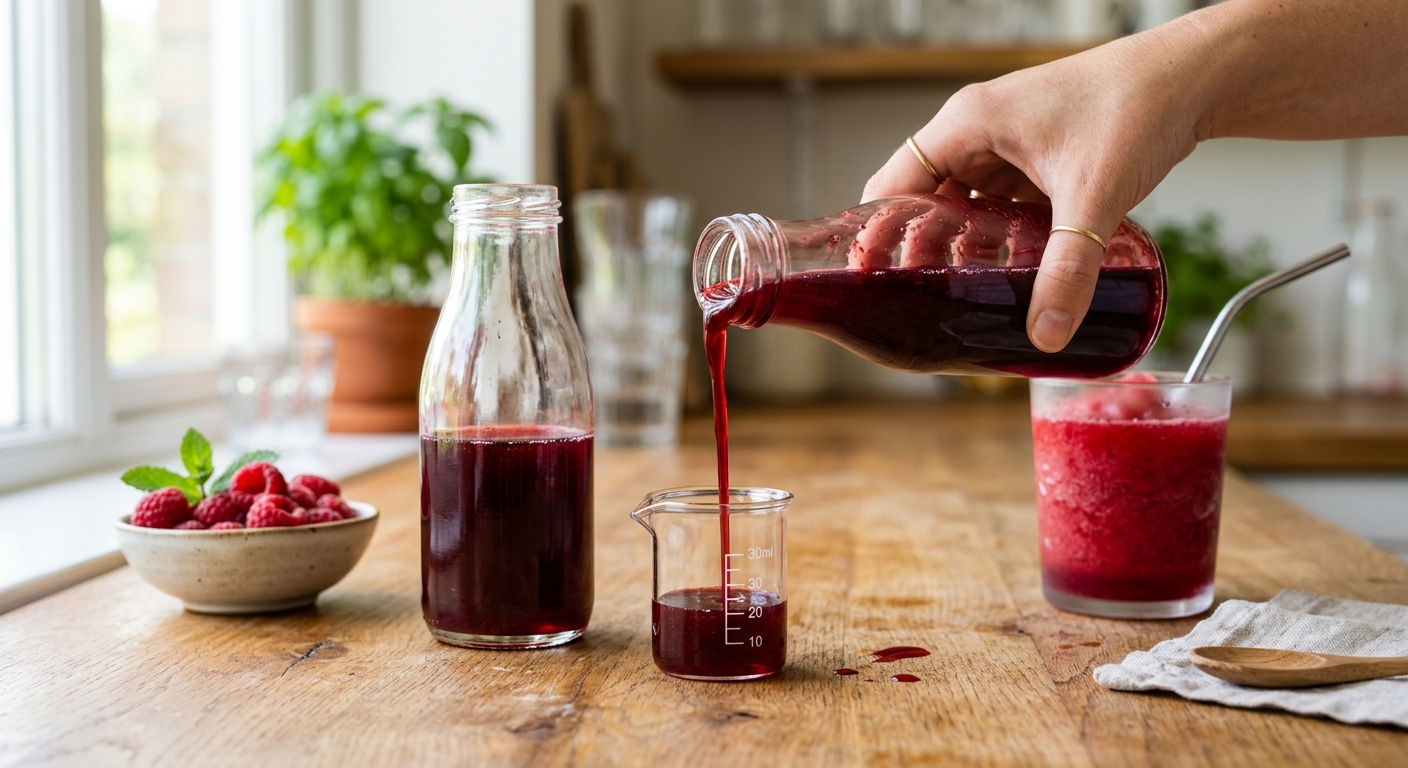
Yes, but read the label before buying. A sugar-free syrup built on xylitol, sorbitol, or vegetable glycerin provides substance and prevents solid freezing. A syrup simply flavored and sweetened with sucralose is colored water from the machine’s point of view: you will need to correct it with a bulking agent.
Is allulose forbidden in France?
It is not authorized for sale as a food ingredient in the European Union, which is not quite the same thing as a ban due to danger. Its novel food file is still under review, and the EFSA opinion of May 6, 2025, concluded that evaluation was impossible due to lack of transmitted data. Status as of September 2026: if you see an authorization pass by, allulose will become the top technical choice again.
In summary, for sugar-free frozen drinks that do not put your machine in error, rely on xylitol and weigh your doses. And you, what substitute do you use in your Slushi, and at what dosage?