
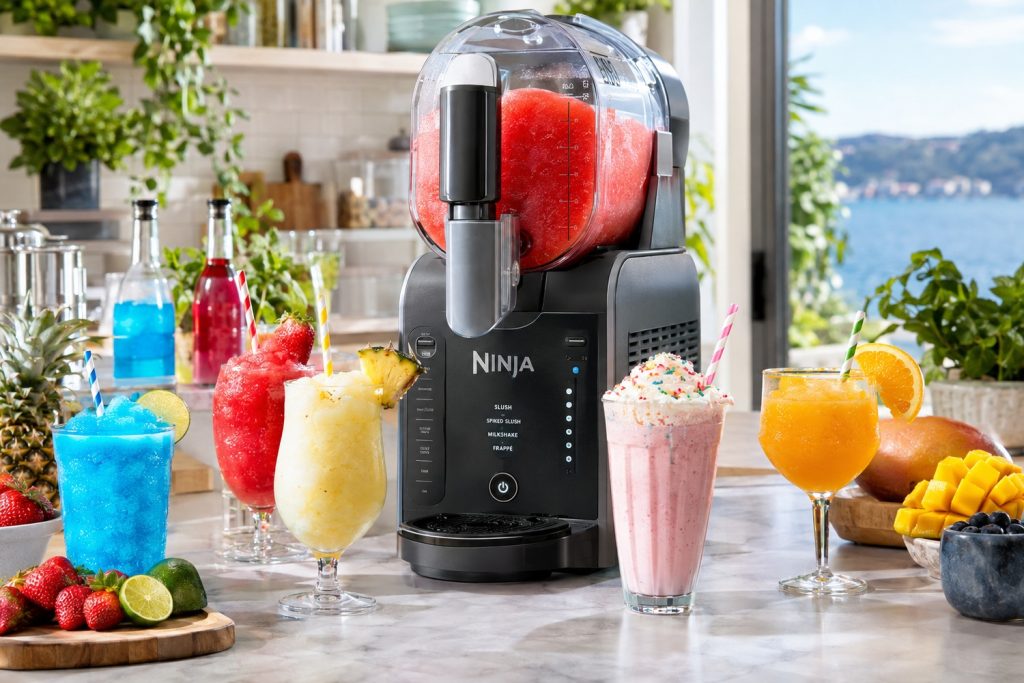
To successfully make an alcoholic cocktail in one of these machines, the secret lies in two key figures: a maximum of 175 ml of spirits per litre of preparation, and a minimum of 4% sugar overall to ensure it freezes properly. This is the classic mistake beginners make: pouring the spirit by eye, as you would in a blender, forgetting that alcohol acts as a powerful antifreeze. I actually learned this the hard way when I first started with the Ninja Slushi (FS301), where I completely prevented my drink from freezing by being too heavy-handed. I spent a whole summer adjusting my margaritas between my FS301 and my Max to find the perfect tipping point without triggering an alert. Here are my benchmarks and exact dosages so you never fail your frozen cocktails again.
Why alcohol dosing cannot be improvised in a Ninja Slushi
The machine’s cooling system relies on a central cylindrical evaporator. The principle is mechanical: the liquid freezes upon contact with this very cold cylinder, and the auger constantly scrapes this thin icy film to create the slush.
However, alcohol acts as a real antifreeze. If it is present in too high a quantity, the mixture simply will not reach its freezing point. The machine will churn in vain. That is why using the Slushi requires following precise mathematical ratios, an approach very different from that of a simple blender where crushed ice does most of the texture work.
Spirits and strong alcohols (35% and above): the volume rule
When handling strong alcohols (rum, vodka, tequila), you must no longer think in terms of global percentage, but rather in strict volume. The recommended reference dosage is approximately 120 ml of spirit for 710 ml of total preparation.
If you are preparing other volumes, the limit not to be exceeded is 175 ml of 40% alcohol per litre of liquid (a benchmark from the FS301 manual, which I cautiously apply to the XL and Max). It is also mandatory to dilute this alcohol into your liquid base (a juice, soda, or syrup) before even pouring the whole thing into the vessel.
| Total preparation volume | Maximum volume of spirits (40%) |
|---|---|
| 500 ml (minimum volume) | ~ 85 ml |
| 710 ml (reference) | 120 ml |
| 1 litre | 175 ml |
| 1.9 litres (max fill for FS301) | ~ 330 ml |
| 2.84 litres (max fill for XL FS601) | ~ 495 ml |
Wines, beers, and premixes: dosing by percentage
For ready-to-drink beverages (wine, beer, cider, or premixes), the logic is different: we look at the alcohol content indicated on the bottle. For the texture to be optimal, your drink should have an alcohol content between 2.8% and 16%.
The lower limit is crucial. If there is less than 2.8% alcohol, the liquid will freeze too hard and too quickly for this mode. You will then have to switch to a classic non-alcoholic programme. In Europe, for all your alcoholic drinks in this range, the Frozen Cocktail programme is the one you must use systematically.
Ninja Slushi XL (FS601) and Max (FS605): the advantage of the Frozen Cocktail Max programme
The larger capacity models offer additional flexibility for slightly more potent preparations. The Ninja Slushi XL (FS601) and the Ninja Slushi Max (FS605) are indeed equipped with an exclusive feature.
Thanks to the Frozen Cocktail Max programme, the limit for ready-to-drink beverages is pushed up to 20% alcohol. Both models also feature SlushAssist, which adjusts the mixing and alerts you if there is a lack of sugar.
The essential alcohol and sugar duo: the 4% rule
Alcohol lowers the freezing point, but it does not replace sugar: the manufacturer requires at least 4% sugar in all liquids.
There is an absolute rule for all machines: every liquid poured must contain at least 4% sugar (i.e., 4 grams of sugar per 100 ml). The risk of an alcoholic but sugar-free cocktail (like vodka mixed with plain sparkling water) is creating extremely hard ice that will strain the auger. If you want to understand the importance of sugar in a healthy base, I recommend you try a Pineapple Elderflower Fizz Mocktail in the Ninja Slushi, an excellent preparation for mastering this ratio without adding any alcohol.
Troubleshooting: alerts and solutions for cocktails
Even with precision, a small calculation error can happen. The appliance is designed to protect itself and will alert you if the recipe is too potent to freeze. The signal is easy to recognise: the temperature lights turn on in an upward sequence. All alerts are decoded in my troubleshooting guide.
The diagnosis is clear: the machine detects too much alcohol. To correct this, you must dilute the preparation. Add about 60 ml of non-alcoholic base per serving (juice, soda, tonic, sparkling water, coffee, or tea). Once this dilution is done, press the button of your programme twice to reset the alert and restart the rotation.
My cheat sheet for frozen cocktails
Before having guests over, here is the routine I apply for every new drink:
- I first check my sugar level (always at least 4%).
- I strictly cap my spirits at 175 ml per litre of liquid.
- Most importantly, I mix everything well in a pitcher before pouring it into the vessel so the alcohol is perfectly distributed.
- I always chill the mixture before pouring it in: the manufacturer suggests between 15 and 60 minutes depending on the volume and starting temperature.
Frequently asked questions
Can I put pure alcohol into my Ninja Slushi?
No, never. The alcohol must imperatively be diluted in a liquid base containing at least 4% sugar, while respecting the limit of approximately 120 ml of spirit for 710 ml of mixture.
Why does my Ninja Slushi cocktail remain liquid?
This is often a sign that there is too much alcohol, which prevents the liquid from reaching its freezing point. The machine will indicate this by lighting up its temperature lights in an upward sequence.
How can I correct an excess of alcohol during the cycle?
According to the official instructions, you must dilute your preparation by adding about 60 ml of liquid (juice, soda) per serving, then press the programme button twice to restart the cycle.
What is the maximum alcohol percentage for wine or beer?
For ready-to-drink beverages (wine, beer), the rate must be between 2.8% and 16% using the Frozen Cocktail programme, and up to 20% in Frozen Cocktail Max on the XL and Max models.
Dosing alcohol requires a little bit of calculation effort during your first attempts, but it guarantees a perfectly frozen result. By respecting the inseparable sugar-alcohol duo and the maximum volumes, you will protect the mechanics of your appliance. Have you ever blocked your machine’s freezing process while attempting a slightly too potent cocktail? Tell me in the comments!