

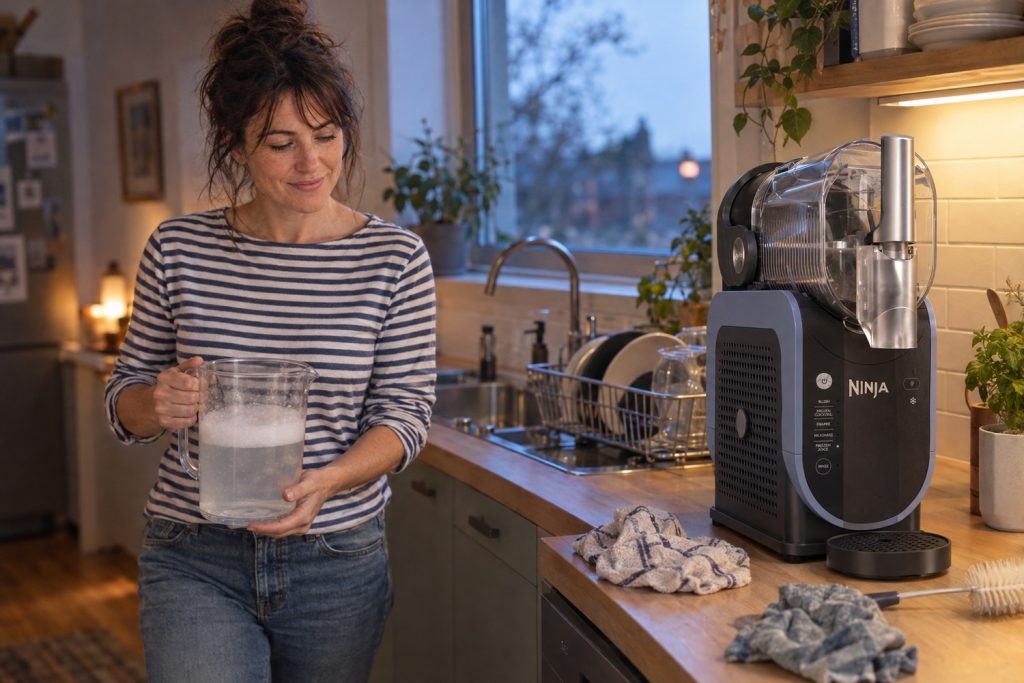
To clean your Ninja Slushi properly without damaging it, the golden rule involves three points: always use the Rinse programme to dissolve sugar before disassembling, place removable parts in the bottom rack of the dishwasher without heat drying, and above all, never touch the seal fixed behind the evaporator. With frozen drinks that strictly require at least 4% sugar to achieve the ideal texture, maintenance is essential to avoid breakdowns. I remember my slight panic the first time I disassembled my Ninja Slushi (FS301), wondering if I had to pull on that famous rear seal, before understanding the manufacturer’s strict rules. With my almost daily use of the FS301, I quickly understood that skipping the pour spout disassembly step would clog the machine in the long run.
Why thorough cleaning is essential
Sugar plays a fundamental role in our appliances: it acts as a natural antifreeze to create the right texture, whether on a classic Ninja Slushi (FS301) or on larger models. However, if it dries, this sugar becomes sticky and quickly clogs the internal mechanisms. The manufacturer’s official rule is strict: you must never leave liquid in the vessel when storing the machine.
The manufacturer recommends running the Rinse programme after each use, then washing the parts. It is the best way to guarantee the longevity of your appliance, especially if you prepare drinks very rich in fruit like the pineapple elderflower fizz mocktail in the Ninja Slushi where the juice gets everywhere.
Express cleaning: the usefulness of the Rinse programme
What is the Rinse programme? It is an ultra-practical programme that allows the auger to spin to stir the water without activating cooling. I start by dispensing what remains of the drink and stop the programme. I then press RINSE, fill the vessel with warm water up to the maximum mark and dispense this water slowly immediately, to loosen the residual sugar on the auger and on the evaporator. If the water still comes out sweet, I start again.
Once the programme is finished, simply turning off the appliance stops the auger and the production of cold. You can then properly empty the machine via the pour spout, which sets the stage for a clean disassembly without sticky drips.
Disassembling the Ninja Slushi safely
To open the machine, start by lifting the handle to unlock the vessel gently. Then slide the vessel towards you to remove it from its axis, releasing the auger and the metal evaporator. Don’t forget to disassemble the front part: carefully remove the pour spout cover as well as its specific seal.
The central evaporator is the centrepiece of the system. Avoid abrasive sponges on this metal cylinder: a soft sponge is enough.
Dishwasher or hand wash: what is allowed
To save time on a daily basis, be aware that many parts are dishwasher safe: the vessel, the auger, and the various parts of the pour spout. However, scrupulously respect these golden rules: place them only in the bottom rack and disable any heat drying function to avoid deforming the plastic, which would compromise the seal.
On the other hand, electrical parts are strictly prohibited in the dishwasher. The motor base and the evaporator are cleaned simply with a soft, damp sponge. I always apply this method after serving an apple ginger mocktail in the Ninja Slushi, because ginger syrup tends to stick a little more than the others.
The trap to avoid: the evaporator seal
If you look at the bottom of the machine, just behind the evaporator, you will see a circular seal. The absolute rule to remember is that this seal is fixed and non-removable.
Do not try to remove it or reposition it: the manufacturer specifies that it is fixed in place to prevent any leaks. Leave it exactly where it is and clean around it with a soft sponge.
Full reassembly and misalignment alerts
Before reassembling the whole thing, ensure the compulsory drying of the pour spout and its seal. The reassembly operation is simply the reverse of disassembly: gently slide the vessel onto its axis, then lower the handle to lock it firmly.
If reassembly is incorrect, the machine warns you with two beeps per minute accompanied by flashing lights.
- If all programme lights are flashing: the vessel is installed incorrectly. Check the alignment and the handle.
- If all temperature lights are flashing: this signals a motor blockage, sometimes due to poor cleaning or stuck sugar. The solution is to unplug the appliance, let it cool for 15 minutes, then disassemble everything to check the condition of the auger. Other alerts are decoded in my troubleshooting guide.
My maintenance memo for damage-free use
- Always run a short Rinse programme with clear water to dissolve the sugar before disassembling.
- In the dishwasher, you must turn off heat drying to avoid deforming the auger.
- Never touch the rear evaporator seal: it is fixed in place.
Frequently asked questions
Can I put Ninja Slushi parts in the dishwasher?
Yes, the vessel, the auger, and the spout parts are dishwasher safe. Place them in the bottom rack and absolutely disable the heat drying function.
Do I need to remove the seal at the bottom of the machine to clean it?
No, certainly not! The manufacturer specifies that the seal behind the evaporator is fixed in place to prevent any leaks: do not remove it.
Can I leave my preparation in the vessel during storage?
No. The manufacturer asks not to leave any ingredients in the vessel during appliance storage: empty it before putting it away.
What is the Rinse programme exactly for?
The Rinse programme allows the auger to spin to stir the water, but without activating the cold. It is perfect for diluting stuck sugar before the actual cleaning.
Proper maintenance is the key to getting impeccable frozen drinks with every use and extending the life of your appliance. Did you have any difficulty putting the pour spout back in place or finding how to run the Rinse programme for the first time? Let me know in the comments!