

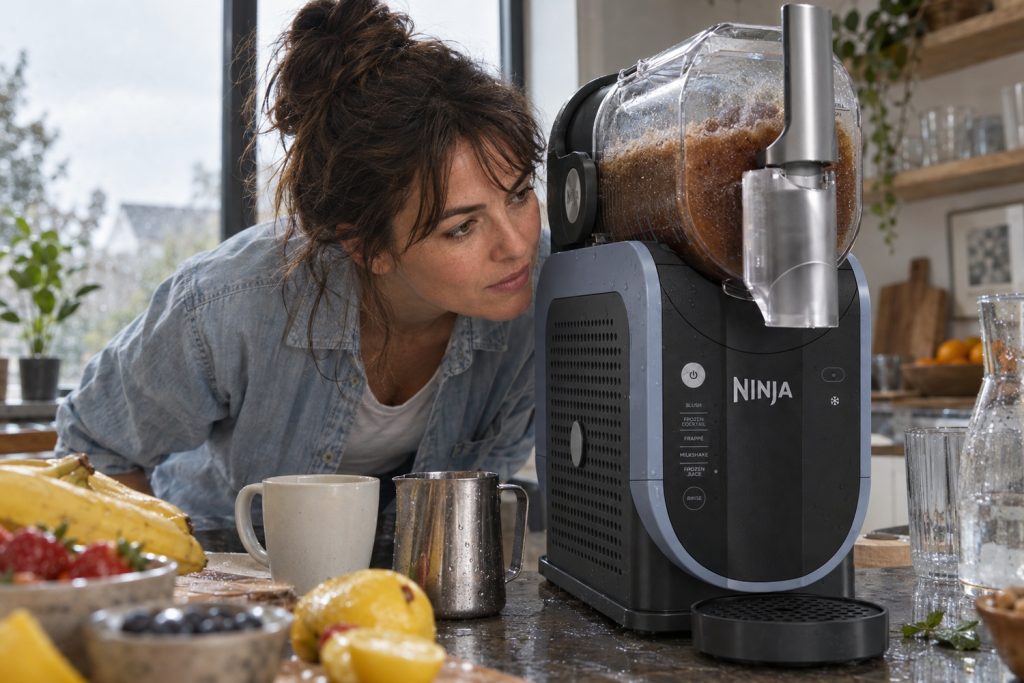
To successfully make a frozen coffee drink in your appliance without stalling the motor, you must add at least 4% sugar (i.e. 4 g per 100 mL) to your cold preparation, and mix everything well before pouring the liquid into the vessel. As a former barista, I immediately wanted to test coffee in my machines, and I tested several ratios on my FS301 to recreate the exact texture of the Greek frappé from my old cafe. The classic mistake is forgetting that espresso or pure cold brew contains no natural sugar: without this crucial element, the ice hardens on the central evaporator, the auger strains and the machine triggers an alert. Here is how to properly adjust your preparations to achieve a perfect texture, from black granita to thick milkshake.
Why pure coffee is your machine’s worst enemy (and how to fix it)
In the world of granita machines, sugar is not just for taste: it acts as an essential antifreeze. The central evaporator of your appliance drops to very low temperatures to crystallise the liquid. Without sugar, the water contained in your coffee will freeze all at once and form a rock-hard block.
The golden rule is simple: you must always incorporate at least 4% sugar in all your liquids to prevent the ice from hardening excessively. Mechanically, if you pour in pure coffee, the frost becomes impossible to scrape, the auger stalls and the machine signals a motor stall.
If you like strong drinks, you will have to be a little clever. To correct a base that is too bitter or lacking in sugar, count on 15 to 30 mL of syrup or honey per serving. The crucial point is to mix this sweetener into your liquid base before pouring it into the appliance. Do not pour granulated sugar or pure syrup directly into the vessel.
Which program to choose according to your Ninja Slushi model
The range offers several models, and they do not all have the same settings. Here is a quick summary to help you choose your programme according to the machine you have on your counter:
| Model | Ideal programme for coffee | Resulting texture |
|---|---|---|
| Ninja Slushi (FS301) | Frappé | Thick, perfect for milky coffee frappés. |
| Ninja Slushi XL (FS601) | Milkshake or Slush | Milkshake for milky versions, Slush for a real black coffee granita. |
| Ninja Slushi Max (FS605) | Milkshake or Slush | Same as the XL, allows for larger quantities. |
The Ninja Slushi (FS301) is the only model in the range to have the dedicated Frappé programme. If you are using the Max or XL model, don’t panic: the Milkshake programme gives excellent results for creamy coffees. For a coffee without animal-based milk, the 12 h cold hold allows the preparation to keep the right texture; it does not apply to milky recipes.
Preparing the coffee base: the golden rules
For the magic to work, a few technical rules are required:
- Temperature: It’s non-negotiable, you are required to use chilled liquids. You should never pour hot coffee into the vessel: the manufacturer does not allow any hot ingredients.
- Minimum volume: Always prepare a minimum of 500 mL of liquid in total so that the auger can stir correctly.
- Setting time: Allow between 15 and 60 minutes depending on the volume, ingredients and starting temperature.
I am often asked if you can speed up the process by adding crushed ice. Important reminder: you must never insert solid ingredients into the machine. The compressor takes care of cooling everything and creating the frost. The manual prohibits ice cubes and any solid ingredients.
My former barista reflex for the Slushi
I always prepare my cold brew or my espressos in advance so that they are perfectly cold when I want to use them. And above all, I always dissolve my sugar or syrup in the liquid coffee before incorporating it into the appliance, to be sure that the 4% antifreeze is evenly distributed. A simple pure espresso poured into the vessel will invariably freeze into a hard block on the central evaporator, and your frozen afternoon will end there! As for coffee, my favourite recipes are the homemade biscoff frappé, the vanilla iced cold brew and the Tim Hortons-style ice capp. To vary the pleasures after a coffee, you can also turn to a caffeine-free drink that is very easy to balance in sugar, like our pineapple elderflower fizz mocktail in the Ninja Slushi.
The sweetener challenge for light coffee frappés
Many users try to bypass sugar with stevia or erythritol. However, the manufacturer asks to avoid artificial sweeteners. The only alternative it mentions is allulose, which makes the drink sweeter. Stevia and erythritol are not in their documentation: these are experiments from the community, to be taken with caution.
Troubleshooting: frequent alerts with coffee drinks
Coffee is temperamental. If your machine beeps twice a minute, it’s a sign that it requires your attention. Here are the two most common cases (all alerts are decoded in my troubleshooting guide):
- Temperature lights going down one by one: This is the clear diagnosis of a lack of sugar. Add 15 to 30 mL of syrup per serving to your base, mixed before pouring it back in, then reset the programme.
- All temperature lights are flashing: This is the signal for a motor stall, the auger can no longer turn. The official procedure consists of unplugging the machine, letting it cool down for 15 minutes, and checking that nothing is obstructing the auger before restarting with a sweeter base.
Machine maintenance after a coffee preparation
Coffee contains oils that can stain, and milk tends to stick. I recommend the systematic use of the Rinse cycle after each preparation to remove coffee and cream residues. Then, you can put the vessel and the auger in the dishwasher (only in the bottom rack, without activating the heated drying).
Remember to remove and dry the pour spout cover as well as its small seal to avoid bad odours. However, take care to leave the evaporator seal in place at the bottom of the machine: it is fixed and not removable.
Frequently Asked Questions
Can I pour my hot coffee into the Ninja Slushi?
No: the manual specifies that you must use chilled liquids, never hot. Let the coffee cool down, or put it in the refrigerator, before pouring.
Why does my Ninja Slushi beep and the lights go down when I make a coffee granita?
This is the official alert for lack of sugar. Without at least 4% sugar, the coffee freezes too hard and the auger strains. You must add syrup (approximately 15 to 30 mL per serving) mixed beforehand so that the texture softens.
Why is the Frappé programme not available on my Ninja Slushi Max?
This is a technical specificity of the range: the Frappé programme is reserved for the base model (FS301). On the Ninja Slushi Max (FS605) or the XL (FS601), you can use the Milkshake programme for your caffeinated preparations and get a very similar result.
Coffee offers endless possibilities with this machine, provided that you always respect the sacred sugar balance to protect your evaporator. Which type of coffee drink do you want most in your Slushi: a very strong black granita or a large creamy caramel frappé?